
Roobet UK Guide / Payments / Withdrawals
International withdrawal terms | Dated
Roobet Withdrawals: General Rules, Fees and Timing
 Available in GB
Roobet’s worldwide withdrawal guidance describes cryptocurrency transfers, a 100% deposit-playthrough rule and blockchain confirmation requirements. Its May 2026 crypto-fee article says Roobet does not charge an operator withdrawal fee, although network fees apply; a separate card article says card or cash withdrawal fees can depend on the method, provider and region. None of this verifies a UK-resident withdrawal service, GBP balance, sterling payout, personal limit or guaranteed arrival time. Roobet’s official restricted-regions notice expressly lists “United Kingdoms” among places whose residents may not access the website or register an account. The details below explain public global documents, not a route for residents in a restricted territory.
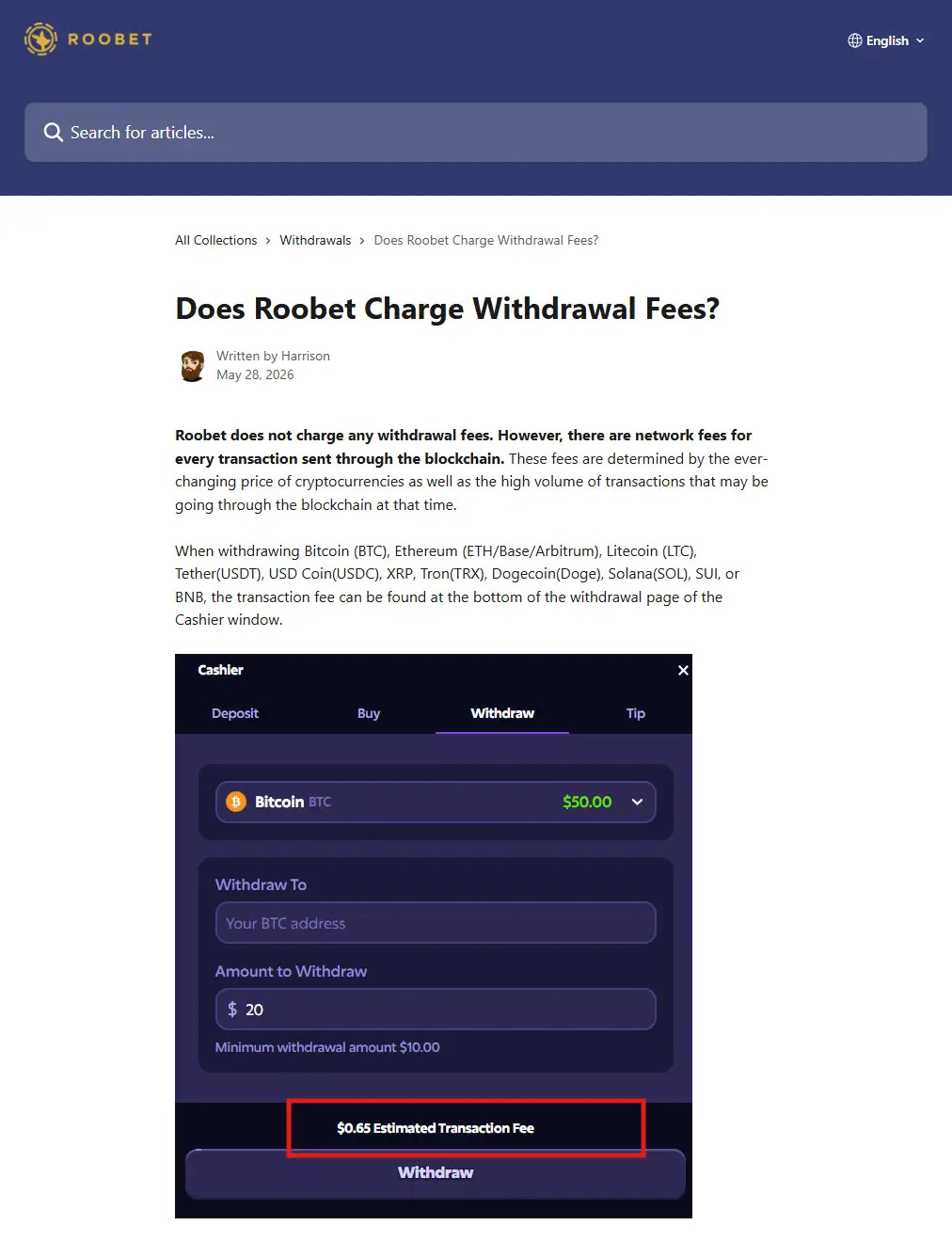
Table of Contents
- Withdrawal conditions for eligible accounts
- Worldwide withdrawal policies
- The 100% deposit-playthrough condition is an AML rule
- Crypto assets, addresses and networks
- Deposit confirmations and wallet confirmations are separate stages
- What “no withdrawal fee” actually means
- Withdrawal timing: dispatch is not receipt
- Minimums, maximums and UK-specific limits
- Identity checks do not disappear when a transfer is on-chain
- Withdrawal fees, timing and eligibility
- Frequently asked questions
Withdrawal conditions for eligible accounts
Roobet describes international crypto withdrawals and separate account, deposit and security conditions. An eligible account can also face blockchain confirmation requirements after a transfer is sent. The published UK-resident restriction remains separate from those international withdrawal mechanics. For related details, see 24 July 2026 cryptocurrency article. Roobet’s general account restriction is described in the Roobet overview.
Related information: payment methods.
Worldwide withdrawal policies
| Operator document | What it establishes globally | What it does not establish |
|---|---|---|
| Restricted Regions, 25 August 2026 | UK residents appear in a general access and registration restriction. | An exception for UK withdrawals. |
| Wagering Requirements, 25 February 2026 | Deposits must be wagered 100% before eligible withdrawal under AML policy. | A welcome-bonus multiplier or UK permission. |
| Crypto withdrawals, 24 July 2026 | Named assets, deposit confirmations and transaction reference details. | Guaranteed wallet receipt or a UK cashier. |
| Withdrawal fees, 28 May 2026 | No operator crypto withdrawal fee claimed; variable network charges remain. | Zero net cost across every payment rail. |
| Card withdrawal fees, 9 June 2026 | Card and cash charges can vary with region and provider. | A UK card withdrawal option or rate. |
Crypto and card withdrawals can have different charges and processes. A global payment-method article does not establish a UK-resident cashout route. For related details, see territorial rules.
The 100% deposit-playthrough condition is an AML rule
The official Wagering Requirements article states that the operator requires 100% of a cryptocurrency deposit to be wagered before funds may be withdrawn, tipped or used in instant raffles. It separately says that 100% of a cash deposit must be wagered before a withdrawal request, and that tipping is not available for cash deposits. The article also specifies that only settled sportsbook bets count towards its wagering measure, and treats received tips under their own provision. These are categories of a general policy, not evidence that every product exists or is permitted in the UK.
Consider a hypothetical deposit value of 100 units solely to understand the wording: a requirement to wager 100% means wagering activity equal to the deposit value, not a promise to recover the original stake, and not a declaration that a £100 deposit facility exists. A wager has financial risk. A 100% deposit condition is not the same as a 100x promotional condition, an account maintenance charge or an extra cash deduction at withdrawal. Mixing those terms produces a false picture of cost and eligibility. This comparison explains documentary language; it is not advice to place a wager or satisfy a restriction.
Crypto assets, addresses and networks
Roobet’s July 2026 guide names BTC, ETH, LTC, USDT, USDC, XRP, TRX, DOGE, SUI, SOL and BNB in its international crypto withdrawal description. An asset name is one piece of evidence; its chain or token network is a second. The separate fee page also mentions Ethereum across main network and named scaling networks. None of these names demonstrates that all combinations are available for every customer, let alone a prohibited resident.
A public blockchain transfer uses a destination address on a particular network. An incorrect asset-network pairing can affect receipt, and the receiving service has its own requirements. The network named for a token must match the applicable operator and receiving-wallet arrangements.
Deposit confirmations and wallet confirmations are separate stages
Roobet’s July crypto guidance says a deposited amount needs at least one network confirmation for BTC, LTC, XRP, TRX or DOGE, and three for ETH, USDT or USDC, before the stated withdrawal or tipping conditions are met. Its deposit-confirmation explanation independently describes why a balance that appears before final network confirmation is not necessarily ready for a withdrawal. These are documented operational prerequisites for the global product; they are not a UK payment-processing timetable.
After an outgoing transfer is sent, the receiving wallet or provider can impose its own confirmation requirement. The July article explicitly notes that some wallets require a different number of confirmations. The same published figure must therefore not be presented as a universal arrival promise. A document that says one confirmation is enough for an operator’s internal check does not establish whether another service will treat the transfer as final. Nor does a chain showing a confirmation prove that any outstanding operator security review has been completed.
What “no withdrawal fee” actually means
In a Help Center article dated 28 May 2026, Roobet states that it charges no withdrawal fee, while every blockchain transfer incurs network fees. That article points to the withdrawal fee information in the operator’s cashier for a crypto transaction. This is a statement about the operator’s published crypto-fee policy, not a claim that a customer always receives precisely the gross amount or that blockchain networks cost nothing.
There is an important second document: its 9 June 2026 card withdrawal FAQ says card or cash withdrawal fees can depend on the payment method, issuing bank, provider and region, and describes the fee information in the applicable cashier. Treating the headline “no withdrawal fee” as a universal claim about cash and card routes would ignore that separate official article. The two descriptions are reconciled by keeping the rail and the charge’s origin visible, rather than claiming every form of payout is free.
| Charge category | Roobet’s published position | Practical meaning |
|---|---|---|
| Operator crypto withdrawal charge | May 2026 Roobet help article says no operator charge. | Do not confuse with a network charge. |
| Blockchain network charge | May 2026 article says it still applies and varies. | No fixed net-receipt amount can be promised. |
| Card or cash withdrawal charge | June 2026 FAQ says it depends on method, provider and region. | No universal zero-fee claim. |
| Exchange or external wallet charge | Not established for an individual arrangement here. | Do not invent a conversion rate or service fee. |
| UK-specific payout or GBP fee | No authorised UK cashier or rate confirmed. | No UK cost quotation is made. |
Withdrawal timing: dispatch is not receipt
Roobet’s 28 May 2026 delayed-withdrawal article says it sends withdrawals as soon as requested, but it does not give a fixed time by which a wallet will receive the transaction because confirmation depends on the blockchain. That is an operator description, not independently measured performance and not a service-level guarantee for a particular user or location. Its usefulness is in identifying the two events that marketing shorthand often collapses into one.
Request time, account verification, funds release, public-chain submission, required confirmations and credit at the receiving wallet are separate events. The public help text cannot tell a reader how long a hypothetical account-specific review would take. It also cannot turn an explorer transaction ID into proof that a third-party custodial wallet has credited the balance. For the UK, neither an operational right to request a payout nor an exact withdrawal interval has been established.
Minimums, maximums and UK-specific limits
Roobet’s international card guidance includes a USD example, not a sterling amount or a UK-issued-card commitment. Its published general terms do not establish a UK-resident minimum, daily cap, monthly cap or guaranteed payout interval.
Withdrawal limits concern the size or frequency of payments. The general deposit-playthrough condition concerns prior wagering activity and is not a withdrawal cap. Neither changes the published UK-resident restriction. For related details, see payment-method details.
Identity checks do not disappear when a transfer is on-chain
Roobet’s public terms reserve the operator’s ability to request verification information and apply checks affecting withdrawals. An irreversible blockchain transaction and a completed KYC review are separate concepts. A token or transaction ID can establish a network event; it cannot establish the user’s legal entitlement, payment-document ownership or account eligibility. A balance display likewise does not establish that all conditions have been satisfied.
Related information: KYC details and account checks.
Withdrawal fees, timing and eligibility
Roobet’s withdrawal conditions distinguish operator charges, blockchain charges, receiving-wallet processing and account checks. The fee and timing can depend on the particular method and transaction, while the general UK restriction governs residence.
- Crypto, card and bank routes can have distinct account and territorial conditions.
- The crypto operator-fee statement does not remove network or provider charges.
- Deposit confirmation thresholds do not establish an outgoing arrival time.
- The general 100% deposit-playthrough rule is distinct from bonus wagering.
- A value converted to GBP does not establish that Roobet supports a sterling balance.
- Does the general UK-resident restriction still apply?
Frequently asked questions
Does Roobet charge a fee to withdraw crypto?
Its help article dated 28 May 2026 says it charges no operator withdrawal fee but that blockchain network charges still apply. That does not prove a zero-cost transfer or an eligible UK transaction.
Does its no-fee statement cover every card payout?
No universal card fee can be drawn from that statement. A separate official card and cash FAQ says charges depend on method, provider, issuing bank and location.
Is the deposit rule a 100x bonus rollover?
No. The official AML article says 100% of the deposit value must be wagered before an eligible withdrawal. Offer-specific wagering is a different term.
How long does an international crypto withdrawal take?
The operator describes prompt dispatch, but says receipt depends on network confirmations and the receiving wallet. Its material gives no universal guaranteed arrival time.
Are UK residents able to use the published withdrawal process?
Roobet’s general terms exclude UK residents from access and registration. Its global withdrawal guidance does not provide a UK-resident payout entitlement.
Prepared by the Roobet Casino editorial staff.